

Sunday, 30 September 2012

Thursday, 27 September 2012
Kitsch and Its Object (T. Kulka) I
"Let us begin by imagining the following situation: Our friend, a competent artist, needs, for some reason, to produce a commercially successful work of kitsch. However, he had no idea what kitsch actually is, and is requesting our advise. What kind of advise could we offer him for creating convincing kitsch? What kind of instructions could we devise, which, if properly executed, would produce a successful kitsch painting?
As we can distinguish between the subject matter of a painting and the manner of its rendering, we can accordingly distinguish between the instructions pertaining to the question of what to paint and those pertaining to the question of how to paint it. In other words, let us consider what sort of objects would be most suitable as subject matter of kitsch, and what kind of rendering would be best suited for this task.
Since figurative and nonfigurative painting are equally legitimate today, the first question is whether our painter should go for a figurative picture or for an abstract one. The answer is clear. It would be evidently more difficult to produce a commercially successful abstract kitsch picture than a figurative one. We seldom call an abstract work kitsch, even if we think is bad.
.jpg)
The next question is whether all objects or themes are equally suitable as the subject matter of kitsch. Clearly, some are more suitable than others. Fluffy little kittens or children in tears would surely do better than an ordinary chair or a washing machine. Let us list some more examples of typical subjects exploited by kitsch. Among the themes that figure most prominently in kitsch pictures are puppies and kittens of various sorts, children in tears, mothers with babies, long-legged women with sensuous lips and alluring eyes, beaches with palms and colourful sunsets, pastoral Swiss villages framed in mountain panorama, pasturing deer in a forest clearing, couples embracing against the full moon, wild horses galloping along the waves of a stormy sea, cheerful beggars, sad clowns, sad faithful old dogs gazing toward infinity... the reader could easily extend the list.
What do these themes have in common? The answer is: they are all highly emotionally charged. They are charged with stock emotions that spontaneously trigger an unreflective emotional response.The subject matter typically depicted by kitsch is generally considered to be beautiful (horses, long-legged women), pretty (sunsets, flowers, Swiss villages), cute (puppies, kittens), and/or highly emotionally charged (mothers with babies, children in tears). This emotional charge does not just typically concur with kitsch; it is a sine qua non. Consider ordinary objects of everyday life that are devoid of any emotional charge: an ordinary chair, or a washing machine. It would, of course, be easy enough to paint bad pictures of chairs or washing machines. However, no matter how hard our painter tried, his efforts would not be rewarded by clear-cut examples of kitsch. Take, on the other hand, an object that is generally considered cute and elicits a ready emotional response: a fluffy little kitten, for example. Not only would it be quite easy to produce such a kitten-depicting work of kitsch, it would actually take some ingenuity to steer clear of it. This dependence on the emotional charge of its subject matter may also explain the difficulty of producing a nonfigurative work of kitsch. Our first advise to our painter should thus be: Choose a subject matter with a clear emotional charge that triggers a ready emotional response."
Kulka, Thomas (2002 [1996]) Kitsch and Art. University Park: The Pennsylvania State University Press. pp 25-26.
Tuesday, 18 September 2012
Architects are the last people that should shape our cities (J. Meades)
Originally published in The Guardian, September 18th, 2012.
Full article by Jonathan Meades
Full article by Jonathan Meades
"Architecture, the most public of endeavours, is practised by people who inhabit a smugly hermetic milieu which is cultish. If this sounds far-fetched just consider the way initiates of this cult describe outsiders as the lay public, lay writers and so on: it's the language of the priesthood. And like all cults its primary interest is its own interests, that is to say its survival, and the triumph of its values – which means building. Architects, architectural critics, architectural theorists, the architectural press (which is little more than a deferential PR machine) – the entire quasi-cult is cosily conjoined by mutual dependence and by an ingrown, verruca-like jargon which derives from the more dubious end of American academe.
[...] Architecture talks about architecture as though it is disconnected from all other endeavours, an autonomous discipline which is an end in itself. Now, it would be acceptable to discuss opera or sawmill technology or athletics or the refinement of lard in such a way. They can be justifiably isolated, for they don't impinge on anyone outside, say, the lard community – the notoriously factional lard community. To isolate architecture is blindness, and an abjuration of responsibility.
If we want to understand the physical environment we should not ask architects about it. After all, if we want to understand charcuterie we don't seek the opinion of pigs. Architects make the error of confusing a physical environment with what they impose on it. Wrong. What is going on around us is the product of innumerable forces. Accidents – some happy, some not – clashes of scale and material, municipal idiocies and corporate boasts – these are some of the more salient determinants of our urban and suburban and extra-urban environments. Buildings are, of course, the major component of these environments. Some of those buildings will be the work of architects. But with the exception of those places where they have been granted the licence to do what they yearn to do – to start from zero – architects have less influence than they believe.
[...] It doesn't matter what idiom is essayed, it is the business of attempting to create places that defeats architects. Architects cannot devise analogues for what has developed over centuries, for generation upon generation of amendments. They cannot understand the appeal of untidiness and randomness, and even if they could they wouldn't know how to replicate it.
New buildings are simple: imagination and engineering. New places are not. It seems impossible to achieve by artifice the parts with no name, the pavement's warts and the avenue's lesions, the physical consequences of changed uses, the waste ground, the apparently purposeless plots.
 |
| www.villadellatorre.it |
It shouldn't be impossible. One cause of this failure is architects' lack of empathy, their failure to cast themselves as non-architects: architect Yona Friedman long ago observed that architecture entirely forgets those who use its products. Another cause of failure is their bent towards aesthetic totalitarianism – a trait Nikolaus Pevsner approved of, incidentally. There was no work he admired more than St Catherine's College, Oxford: a perfect piece of architecture. And it is indeed impressive in an understated way. But it is equally an example of nothing less than micro-level totalitarianism. Arne Jacobson designed not only the building, but every piece of furniture and every item of cutlery.
At macro-level, a so-called master planner will attend to the details of streets, avenues, drop-in centres, houses, offices, bridges. The master planner is almost certainly an architect, even though planning and architecture are contrasting disciplines. There are countless differences between a suburb and, say, a shopping mall in that suburb. We are all familiar with the hubristic pomp that often results when actors direct themselves. Appointing architects to conceive places is like appointing foxes to advise on chicken security.
The human ideal is to revel in urbanistic richness, in layers of imperfection. [...] The overlooked can only survive so long as authority is lax. When authority goes looking for the overlooked, the game is up – as it is today in the Lea Valley in east London. The entirely despicable, entirely pointless 2012 Olympics – a festival of energy-squandering architectural bling worthy of a vain, third-world dictatorship, a payday for the construction industry – occupies a site far more valuable as it was. It was probably the most extensive terrain vague of any European capital city. The English word "wasteland" is pejorative, lazy and more or less states that the place has no merit – so why not cover it in expressions of vanity?
[...]What an architect sees, blindly and banally, is not richness and severality. But, rather, something that is crudely classified as a brownfield site, that is tantamount to being classified as having no intrinsic worth. It is a non-place where derivative architecture can gloriously propagate itself with impunity. A brownfield site is a job opportunity, a place where the world can be physically improved. The architectural urge doesn't acknowledge the fact that it'll all turn to dust."
Monday, 20 August 2012
Shark Girl Riding a Pig
.jpg) |
| Shark Girl Riding a Pic, Casey Riordan Millard (i.imgur.com) |
"Casey Riordan Millard graduated with a BFA from Ohio University, Athens, Ohio in 1994. She has exhibited her large-scale installations, ceramic works, paintings and drawings in galleries throughout the United States including the Fuller Craft Museum, Brocton, Massachusetts, Cincinnati Art Museum, John Michael Kohler Center for the Arts, Sheboygan, Wisconsin and Packer-Schopf Gallery, Chicago, Illinois. Her work is in the permanent collection of the Cincinnati Art Museum and has been featured in the publications Hi-Fructose Magazine, New American Paintings, Lark Studio Series Ceramic Sculptures, and Lark’s 500 Ceramic Sculptures. In 2009 she received an Efroymson Contemporary Art Fellowship and in 2011 was a finalist in the Cincinnati Art Museum’s Fourth Floor competition. Her work will be featured in October of 2012 at the UnMuseum in Cincinnati’s Contemporary Arts Center. Currently, she lives and works in Cincinnati, Ohio."
Wednesday, 15 August 2012
Palacio Dorado Hotel (O. Chuquiruna)
Octavio Chuquiruna, Peruvian builder (not a professional architect). A recent work northern Lima.
"I've always liked detail." he says, "to do a good façade, to make suggestions to the owner. Sometimes, because of economic reasons, the owner would say to me, 'no, do it just simple,' but I would say to him, 'What if we put just a little shape here?'. The owner, happily, would say to me, 'let's do it,' and he would be very pleased."


El Palacio Dorado. Av. Puente Piedra Sur, 1308.
Chuquiruna, O. (2002) "Diseñando la ciudad". In: Coloquio Lo cholo en el Perú. Migraciones y Mixtura. Lima: Biblioteca Nacional. p 166.
"I've always liked detail." he says, "to do a good façade, to make suggestions to the owner. Sometimes, because of economic reasons, the owner would say to me, 'no, do it just simple,' but I would say to him, 'What if we put just a little shape here?'. The owner, happily, would say to me, 'let's do it,' and he would be very pleased."


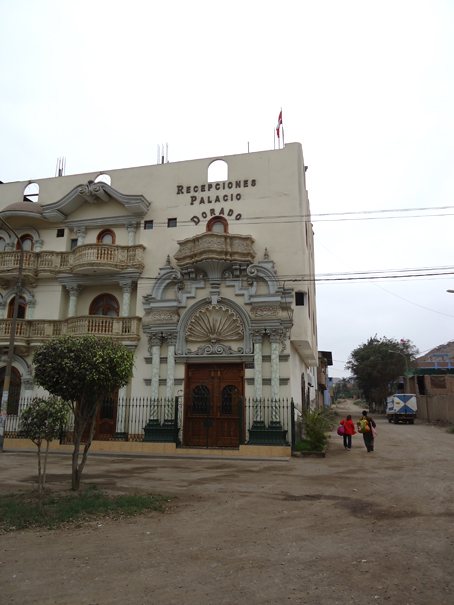


El Palacio Dorado. Av. Puente Piedra Sur, 1308.
Chuquiruna, O. (2002) "Diseñando la ciudad". In: Coloquio Lo cholo en el Perú. Migraciones y Mixtura. Lima: Biblioteca Nacional. p 166.
Saturday, 4 August 2012
Mockitecture: Honestly, Why? Are you Serious?
 |
| mockitecture.blogspot.com |
The authors of this post have a blog called Mochitecture, which, as far as I understand it, is another way to refer to kitsch architecture. They talk about it, present examples of it and, ultimately, try to identify some sort of "mockitectural theoros".
Here, a little example of the goals they've identify on mockitecture, which I think are a lot like those of kitsch architecture.
"Goals of mockitecure...
- attempts to continue tradition of california crazy and architectural folly as well as post modernism while incorporating technology and traditional architectural theory and ethics
- critiques the ambiguity and pompous gestures of contemporary architecture- underscores a lighter side of architecture, both tectonically and critically
- make light of the vocabulary used in architectural discourse
- theorizes a new attitude about playfulness and architecture
- makes light through critique of bad architectural solutions and ideas"
Full article here: Mockitecture: Honestly, Why? Are you Serious?
Tuesday, 31 July 2012
The Metropolis and Mental Life (G. Simmel)
"The deepest problems of modern life flow from the attempt of the individual to maintain the independence and individuality of his existence against the sovereign powers of society, against the weight of the historical heritage and the external culture and technique of life. This antagonism represents the most modern form of the conflict which primitive man must carry on with nature for his own bodily existence. The eighteenth century may have called for liberation from all the ties which grew up historically in politics, in religion, in morality and in economics in order to permit the original natural virtue of man, which is equal in everyone, to develop without inhibition; the nineteenth century may have sought to promote, in addition to man’s freedom, his individuality (which is connected with the division of labour) and his achievements which make him unique and indispensable but which at the same time make him so much the more dependent on the complementary activity of others; Nietzsche may have seen the relentless struggle of the individual as the prerequisite for his full development, while socialism found the same thing in the suppression of all competition—but in each of these the same fundamental motive was at work, namely the resistance of the individual to being levelled, swallowed up in the social-technological mechanism. When one inquires about the products of the specifically modern aspects of contemporary life with reference to their inner meaning—when, so to speak, one examines the body of culture with reference to the soul, as I am to do concerning the metropolis today—the answer will require the investigation of the relationship which such a social structure promotes between the individual aspects of life and those which transcend the existence of single individuals. It will require the investigation of the adaptations made by the personality in its adjustment to the forces that lie outside of it.
The psychological foundation, upon which the metropolitan individuality is erected, is the intensification of emotional life due to the swift and continuous shift of external and internal stimuli. Man is a creature whose existence is dependent on differences, i.e. his mind is stimulated by the difference between present impressions and those which have preceded. Lasting impressions, the slightness in their differences, the habituated regularity of their course and contrasts between them, consume, so to speak, less mental energy than the rapid telescoping of changing images, pronounced differences within what is grasped at a single glance, and the unexpectedness of violent stimuli. To the extent that the metropolis creates these psychological conditions—with every crossing of the street, with the tempo and multiplicity of economic, occupational and social life—it creates in the sensory foundations of mental life, and in the degree of awareness necessitated by our organization as creatures dependent on differences, a deep contrast with the slower, more habitual, more smoothly flowing rhythm of the sensory-mental phase of small town and rural existence. Thereby the essentially intellectualistic character of the mental life of the metropolis becomes intelligible as over against that of the small town which rests more on feelings and emotional relationships. These latter are rooted in the unconscious levels of the mind and develop most readily in the steady equilibrium of unbroken customs. The locus of reason, on the other hand, is in the lucid, conscious upper strata of the mind and it is the most adaptable of our inner forces. In order to adjust itself to the shifts and contradictions in events, it does not require the disturbances and inner upheavals which are the only means whereby more conservative personalities are able to adapt themselves to the same rhythm of events. Thus the metropolitan type— which naturally takes on a thousand individual modifications—creates a protective organ for itself against the profound disruption with which the fluctuations and discontinuities of the external milieu threaten it. Instead of reacting emotionally, the metropolitan type reacts primarily in a rational manner, thus creating a mental predominance through the intensification of consciousness, which in turn is caused by it. Thus the reaction of the metropolitan person to those events is moved to a sphere of mental activity which is least sensitive and which is furthest removed from the depths of the personality."
Simmel, G. (1903) The Metropolis and Mental Life. En: Leach, Neil (ed.) (1997) Rethinking Architecture. London: Routledge. p 68.
.jpg) |
| New York City 1903 (digitalgallery.nypl.org) |
Saturday, 28 July 2012
A Set of Building Blots (C. F. Brown) II
"All within a few miles of downtown Manhattan and all within a few blocks of one another, these houses illustrate some home buyers' low sales resistance to anything that looks "elegant," "exotic," or "extraordinary." Here, you can learn how to play mix-and-match Domestic Architectural Kitsch.
Take one basic shingled box, add plywood arches, one stuccoed brick buttress, a paneled plastic garage door, and call it Spanish.
Take the same basic box, apply a stucco crenelated façade, rustic permastone base, two paneled plastic front doors, and you get a duplex Norman keep.
Enlarge the box, add Cape Codcottage weathered shingles, a formal Federal broken pediment above the entrance, a few spindly columns, and you achieve Early American.
Borrow the bay window from the first house, the garrison front from the "Spanish" or "Norman" house, pillars from the "Early American" house, and the all-purpose Olde Time diamond window panes, add a Venetian porch lantern, and voilà: All-American International Kitsch."
Brown, Curtis F. (1975) Star-Spangled Kitsch. New York: Universe Books. pp 87-88.

Take one basic shingled box, add plywood arches, one stuccoed brick buttress, a paneled plastic garage door, and call it Spanish.
Take the same basic box, apply a stucco crenelated façade, rustic permastone base, two paneled plastic front doors, and you get a duplex Norman keep.
Enlarge the box, add Cape Codcottage weathered shingles, a formal Federal broken pediment above the entrance, a few spindly columns, and you achieve Early American.
Borrow the bay window from the first house, the garrison front from the "Spanish" or "Norman" house, pillars from the "Early American" house, and the all-purpose Olde Time diamond window panes, add a Venetian porch lantern, and voilà: All-American International Kitsch."
Brown, Curtis F. (1975) Star-Spangled Kitsch. New York: Universe Books. pp 87-88.

Monday, 16 July 2012
A Set of Building Blots (C. F. Brown) I
"A traveller in Kitshland will observe that the territory is not neatly circumscribed. Shifting perspectives can alter the boundaries. Nowhere is this clearer than in the region of architecture, where, depending on the point of view, one man's castle can be taken for another man's kitsch.


[...] Architectural kitsch often has the desperate air of someone who, eager to create a striking impression, both speaks and dresses too loudly. 'Look at my fantastic clothes, my fabulous hair style, and my out-of-this-world jewellery. Aren't you staggered at the thought of what it all must have cost?'"
Brown, Curtis F. (1975) Star-Spangled Kitsch. New York: Universe Books. pp 87-88.

Saturday, 14 July 2012
Heavenly calling
"The recently restored St. Jan's Cathedral in the Dutch city of 's-Hertogenbosch (hortened to 'Den Bos'), boasts an unusual statue. Sculptor Ton Mooy spent 14 years carving some 40 new statues for the cathedral's exterior. While most of them are the standard fare adorning age-old churches, Mooy couldn't resist adding a modern version: an angel with a mobile phone. "The church leaders took some convincing, but in the end, they went for it." he says. A small replica of the statue can be purchased via ben-engel.nl."

Holland Herald, Vol 47, Nº 07, July 2012.
Media Partners Group. Amstelveen.

Holland Herald, Vol 47, Nº 07, July 2012.
Media Partners Group. Amstelveen.
Tuesday, 26 June 2012
Moving through the bazaar (T. Edensor)
.JPG)
"Bazaars constitute an unenclosed realm which provides a meeting point for a variety of people and multiple activities, including forms of 'recreations, social interaction, transport and economic activity' (King, 1976: 56). Not dominated by one economic activity, bazaars mix together small businesses, shops, street vendors, public and private institutions and domestic housing. Hotels co-exist alongside work places, schools, eating places, transport temini, bathing points, political headquarters, offices, administrative centres, places of worship and temporary and permanent dwellings. This multi-functional structure provides a mixture of overlapping spaces that seem to merge Western dichotomous notions of public and private, work and leisure, and holy and profane. And the bazaar contains a host of micro-spaces: corners and niches, awnings and offshoots, providing a labyrinthine structure with numerous openings and passages which enables a flow of different bodies and vehicles with criss-cross the street in multi-directional patterns, veering into courtyards, alleys and cul-de-sacs.
.JPG) Bazaars are 'centres of social life, of communication, of political and judicial activity, of cultural and religious events and places for the exchange of news, information and gossip' (Buie, 1996: 277). Everyday social activities such as loitering, sitting and observing, and meeting friends, are organized around particular micro-spaces such as transport termini and tea stalls. The street is often a site for domestic activities such as collecting water, washing clothes, cooking and child-minding. For some, streets may serve as a temporary home, necessitating the carrying out of bodily maintenance such as washing. Such temporary sites and activities challenge notions of ownership, and the distinction between private and public (Chandhoke, 1993).
Bazaars are 'centres of social life, of communication, of political and judicial activity, of cultural and religious events and places for the exchange of news, information and gossip' (Buie, 1996: 277). Everyday social activities such as loitering, sitting and observing, and meeting friends, are organized around particular micro-spaces such as transport termini and tea stalls. The street is often a site for domestic activities such as collecting water, washing clothes, cooking and child-minding. For some, streets may serve as a temporary home, necessitating the carrying out of bodily maintenance such as washing. Such temporary sites and activities challenge notions of ownership, and the distinction between private and public (Chandhoke, 1993).
[...] Heterogeneous spaces such as bazaars are typically subject to contingent and local forms of planning and regulation, and surveillance is rather low-level. Rather than security guards and video surveillance, local power-holders exercise policies of exclusion and control. Forms of restriction over movement do apply. There may be gendered conventions about who should pass through particular public spaces, and other local struggles over space, shaped around class, ethnic and religious conflicts, may persist. Yet such restrictions are often foiled by intrusions that challenge the spatial ordering of the city. For instance, the 'unintended city' of the 'shanty town' insistently projects into and subverts planned urban spaces.
[...] Whilst formal traffic rules exist, vehicles pay little heed to them as they jostle for position, creating a competitive and rather chaotic race for road space. Itinerant beggars and workers are rarely advised to 'move on', and while the animals that share the streets may be subject to cruelty, there are few systematic attempts to control their movements or numbers. Aesthetically, the maintenance of a cultivated appearance through control or theming is rarely imposed; an unplanned bricolage of structures is infested with ad hoc signs, contingent and personalized embellishments, and unkempt surfaces and facades.
The pedestrians who move through this protean space are denied the option of seeking refuge in an aloof disposition and are often thwarted in their desire for rapid progress. For it is often difficult for them to move in a straight line. Instead they must weave a path by negotiating obstacles, and remain alert to hazardous traffic and animals [...]. The abundant simultaneous cross-cutting journeys mean that pedestrians must take count of others who will cross their path at a variety of speeds. In addition, the miscellaneous collections of vehicles and other diverse forms of transport, all moving at different speeds as they manoeuvre for space, provides an ever-changing dance of traffic which echoes the stop-start choreographies of pedestrians. Walking cannot be a seamless, uninterrupted journey but is rather a sequence of interruptions and encounters that disrupt smooth passage.
This disrupted progress is not only produced through the exigencies of avoiding collisions, but also by the distractions and diversions offered by heterogeneous activities and sights. There is an ever-shifting series of juxtapositions and assemblages of diverse static and moving elements which can provide surprising and unique scenes. Such haphazard features and events dis-order the gaze as the eye continuously shifts, alighting on changing episodes to the left and right, far ahead and close at hand. Moreover, the pleasurable jostling in the crows engenders a haptic geography wherein there is continuous touching of others and weaving between and amongst bodies. The different textures brushed against and underfoot render the body aware of diverse tactile sensations. These impacts on the haptic system of the body produce distinct forms of feeling and experience (see Lyon and Barbalet, 1994). Additionally, the 'smellscapes' and 'soundscapes' of the bazaar are rich and varied. The jumbled mix of pungent aromas (sweet, sour, acrid and savoury) produces intense 'olfactory geographies', and the combination of noises generated by numerous human activities, animals, forms of transport and performed and recorded music, produces a changing symphony of diverse pitches, volumes and tones.
.JPG)
It seems as if the sensual and social body moving through the bazaar is continually imposed upon and challenged by diverse activities, sensations and sights which render a state at variance to a restrained and aloof distraction. Rather than being a distanced spectator of manufactured spectacle, the pedestrian is part of a heterotopic diversity where the senses are excited by a more variegated set of stimuli."
Edensor, Tim (2000) "Moving through the city". En: Bell, David; Haddour, Azzedine (eds.) City Visions. Essex: Pearson Education Limited.
References:
Buie, S. (1996) Market as mandala: the erotic space of commerce. Organisation, 3, 225-32.
Chandhoke, N. (1993) On the social organisations of urban space - subversions and appropriations. Social Scientist, 21, 63-73.
King, A. (1976) Colonial Urban Development: Culture, Social Power and Environment, Routledge, London.
Lyon M. and Barbalet, J. (1994) Society's body: emotion and the 'somatisation' of social theory. In Csordas, T. (ed.) Embodiment and Experience, Cambridge University Press, Cambridge.
Thursday, 14 June 2012
Kitsch As Only Kitsch Can (C. F. Brown)
 "After All, If Kitsch Isn't a Pleasure, Why Bother?
Bonjour, pardner, and a real warm wlcome to a wunnerful world of charm and elegance, heart-warming adorableness, and delightfully perverse American ingenuity.
Like it or not, kitsch is the daily, everywhere art of our time, and because we are surrounded by it - in stores and shoppes, in mail-order catalogs, in public events and popular entertainment - we accept it, decry it, or try, probably futilely, to ignore it. If you're a snob, kitsch is the stuff the neighbors collect, not the lovely things that add to the joy and richness of living in your gracious home.
First, a ground rule before we begin our Gradus ad Parnassum to the dizzying heights of kitsch at its most flamboyant, most outrageous, and - Heaven help us all - its most lovable. Don't think of kitsch as either "good" art or "bad" art. Most of it hasn't the least idea of being the first, so why should it be labeled, by default, the other? Certainly, kitsch has its grandiose pretensions, its pomposities, its megalomania, even; but its aspirations are not toward what the collective opinion of critics calls Art. Kitsch objects are not more the "opposite" of art than kitsch social phenomena are the counterpart of "nice" norms of behavior or "acceptable" attitudes. Instead, kitsch fills another kind of bill: it feeds the mass appetite for the slick, the sentimental, the sensational, and the supercolossal.
Kitsch need not mean the fall of Western civilization through cultural selft-abasement. Like Archbald MacLeish's rationale for a poem, kitsch doesn't mean, only is.
Let's begin our Stairway to Paradise with a simple example, a sweat shirt emblazoned with a printed likeness of Leonardo's Mona Lisa. Few people are likely to mistake that combination of art and apparel for Art. The buyer is perfectly aware that the decorated shirt is not unique, but a widely available commodity. However, even a sweat shirt, if it bears a picture of a Timeless Masterpiece, not a campy or trendy one of Bugs Bunny or Mick Jagger, can transcend the utilitarian and spell Class.
That is what much of kitsch art generally is, a mass-produced item that its purchaser believes endows him with an air of richness, elegance or sophistication. (The American art critic Meyer Schapiro wryly defines kitsch as "chic spelled backwards")."
Brown, Curtis F. (1975) Star-Spangled Kitsch. New York: Universe Books. p 9.
Subscribe to:
Posts (Atom)
