Showing posts with label definition. Show all posts

Tuesday, 5 December 2017

The Kitsch Style and the Age of Kitsch (N. Elias)

"[...] It has sometimes been said that the eighteenth century was the last to have a 'style' at all. And indeed, hardly has anyone dared to entertain the idea of a capitalist style that the doubts set in: Can one still speak of a 'style' in this context? It seems clear the the rise of bourgeois professional and industrial society was marked not only bu the replacement of one aesthetic, one 'style' bu another, but by the collapse of a coherent set of typical expressive forms. The aesthetic productions of capitalist society therefore tend to be described, far more than earlier ones, in relation to the single creative individual, or at most to various schools and tendencies. The existence of a unified development of forms and of common, typical basic structures, in short, of a 'style' of artworks in he capitalist world, remains more or less obscure. Names have been found, at most, for episodes in this development, for example, the so-called Jugendstil. A more comprehensive name is lacking, and the problem itself has hardly yet emerged into our consciousness.

If the term 'kitsch style' is used here to fill this gap, that may seem like a piece of eccentricity or even a malicious depreciation of the art of our time. In reality, the choice of this term is anything but a tendentious whim. For if we look beyond the general terms 'capitalist' or 'liberal' for underlying concepts expressing what is uniform in capitalist aesthetic idiom, after much sifting of terms which are either colourless or imply a positive evaluation, one comes across this term as one of the very few which express a pervasive feature of capitalist aesthetic products. To be sure, the term 'kitsch' is unclear enough in common usage. But if it can and should mean anything more than a random generality to embrace the concrete phenomenon which underlies its topicality in our day, then its content and boundaries must be sought in the evolution of aesthetic form within bourgeois society. That the peculiarity of an age first becomes visible from a negative aspect is certainly not without precedent in history. Originally, terms such as 'Baroque' or 'Gothic' did not have much more positive ring than 'kitsch' has today. Their value-content changed only in the course of social development, and - without giving undue weight to historical parallels - the term 'kitsch style' is sent on its way here with the same likelihood and expectation that its value may change, and to help prepare for such a change. it is used, first of all, to designate the stylistic character of the pre-war period. But no one is able to say whether we ourselves are not still 'pre-war' - that is, more closely tied to the pre-1914 period, when seen in a historical perspective - than appears to us today from our close, foreshortening viewpoint. 

What the term 'kitsch style' is intended to express first of all is an aesthetics quality of a very peculiar kind, namely the greater formal uncertainty inherent in all artistic production within industrial society. This can already be seen in the very early stages of the bourgeois-capitalist era. For to begin with liberal-bourgeois society certainly did not express itself in entirely new forms. Ornamentation persisted, and Empire and Biedermeier were clearly descendants of the old court style. What was lost, above all, was the certainty of taste and of the creative imagination, the solidity of the formal tradition which was discernible earlier in even the clumsiest products. Outburst of feeling of unprecedented intensity shattered the old forms; groping for new ones, artists produced some well-formed works but, to an unprecedented degree, others marked by an extreme want of clarity and taste. In this groping, this coexistence of high standards with a total lack of standards, not only in different artists but often in one and the same individual, the change structure of the artistic process found especially vivid expression. For even the most capable artist the lapse into formlessness now became an acute and constant threat. Every successful, fully-formed work was now wrested from the abyss to a quite different extent than had been the case earlier, when a firm social tradition both fettered and sustained the creative urge. [...] Kitsch in the negative sense, therefore, is never only something antagonistic existing outside the true creators, but is also a basic situation within them, a part of themselves. This incessant interpenetration of structure and disintegration is a feature of the lasting regularity to be observed in industrial society. [...] The powerful accentuation, the peculiarly artificial and sometimes almost convulsive intensity of form characteristic of some of the greatest modern artists, expresses, fundamentally, nothing other than this insecurity, this unabating struggle against formlessness and disintegration which even the most accomplished artists have to wage today. [...] So much, in our age, has dilapidation become a constitutive element, decisively affecting even the positive aspect of artistic works. And, as we can see, the re-evaluation of kitsch as a positive concept begins at this point."

Elias, Norbert (1935) "The Kitsch Style and the Age of Kitsch". In: Goudsblom, J., Mennel, S. (1998) The Norbert Elias Reader. Oxford. Blackwell. pp 27-29.

Thursday, 15 January 2015

Art, Kitsch and Art History (A. Brzyski)

The Widow, Frederick Dielman
(Boston Public Library, upload.wikimedia.org)
"On the most basic level kitsch is not art. Our ability to distinguish between the two terms - even in those instances when kitsch approximates the appearance and logic of art and art that of kitsch - marks us as members of the cultural elite. Precisely because we are aware of their crucial dissimilarity, we can identify, discuss, and diagnose a wide range of phenomena usually associated with popular or mass culture as kitsch. We can even indulge in kitsch as camp, because unlike the actual consumers of kitsch, who lack the necessary critical distance and therefore fail to recognize kitsch for what it is, we know better. As Susan Sontag noted in the 1960s, our eager willingness to watch the very best "bad movies" or to relish with a hint of revulsion the extravagantly "awful" reveals our membership in the hip inner circle. Kitsch is therefore our term for their lack of taste and as such always a value judgement made from a position absolute cultural superiority.

But what exactly is that we mean when we identify something as kitsch? At different times, different authors have used this label to denigrate nineteenth century academic paintings, anything made by Salvador Dalí, various "inappropriate" forms of art reproduction, decorative bric-a-brac, political propaganda, votive objects, erotic images, advertisements, and Hollywood movies. The diversity of this list and the seeming lack of consensus among those disparate phenomena under the same rubric may be based on external considerations rather than any qualities shared among them. The pertinent question with regards to kitsch appears to be, therefore, not what is kitsch, but rather what exactly is meant when that label is applied to something.

Brzyski, Anna (2013) Art, Kitsch and Art History. In: Kjellman-Chapin, Monica, Kitsch. History, Theory, Practice. Newcastle upon Thyne: Cambridge Scholars. p 1.

Wednesday, 12 December 2012

Kitsch (F. Gualdoni)

"Around 1860 in Germany the expression Kitsch starts to grow, indicating an aesthetic operation of counterfeit and pastiche. The etymology is indicative: Kitschen means the act of building old furniture with old parts, and Verkitschen, to sell something different that what has been announced. At the same time, then, the term refers to something related with the non-authentic reproduction of something that already existed, and suggest that its main object of said action is to satisfy a need that has something to do with taste, with expectations of cultural consumption.

The moment is determinant. The start-up of the second half of the nineteenth century is that in which bourgeoisie and small bourgeoisie are definitely established as the main components of an evolved European society, or rather the German, French and English society. Said social groups do not present specific cultural forms that identify them, as what happens in one hand to aristocracy and to the other hand to the lower classes, still anchored to popular culture, limited but defined. The bourgeoisie aspires instead, by the attraction that naturally pose the more mature lifestyles to those inferior, to be precipitants of the aristocratic culture of the high classes: such involvement is rather seen as an essential element in the climbing up to an eminent and acknowledged social role, to distinctive traits of a long cherished exclusivity."

Gualdoni, Flaminio (2008) Kitsch. Milano: Skira. p 7

Corbis

Saturday, 4 August 2012

Mockitecture: Honestly, Why? Are you Serious?

mockitecture.blogspot.com
The authors of this post have a blog called Mochitecture, which, as far as I understand it, is another way to refer to kitsch architecture. They talk about it, present examples of it and, ultimately, try to identify some sort of "mockitectural theoros".

Here, a little example of the goals they've identify on mockitecture, which I think are a lot like those of kitsch architecture.

"Goals of mockitecure...
- attempts to continue tradition of california crazy and architectural folly as well as post modernism while incorporating technology and traditional architectural theory and ethics
- critiques the ambiguity and pompous gestures of contemporary architecture
- underscores a lighter side of architecture, both tectonically and critically
- make light of the vocabulary used in architectural discourse
- theorizes a new attitude about playfulness and architecture
- makes light through critique of bad architectural solutions and ideas"

Full article here: Mockitecture: Honestly, Why? Are you Serious?

Thursday, 14 June 2012

Kitsch As Only Kitsch Can (C. F. Brown)

"After All, If Kitsch Isn't a Pleasure, Why Bother?

Bonjour, pardner, and a real warm wlcome to a wunnerful world of charm and elegance, heart-warming adorableness, and delightfully perverse American ingenuity.

Like it or not, kitsch is the daily, everywhere art of our time, and because we are surrounded by it - in stores and shoppes, in mail-order catalogs, in public events and popular entertainment - we accept it, decry it, or try, probably futilely, to ignore it. If you're a snob, kitsch is the stuff the neighbors collect, not the lovely things that add to the joy and richness of living in your gracious home.

First, a ground rule before we begin our Gradus ad Parnassum to the dizzying heights of kitsch at its most flamboyant, most outrageous, and - Heaven help us all - its most lovable. Don't think of kitsch as either "good" art or "bad" art. Most of it hasn't the least idea of being the first, so why should it be labeled, by default, the other? Certainly, kitsch has its grandiose pretensions, its pomposities, its megalomania, even; but its aspirations are not toward what the collective opinion of critics calls Art. Kitsch objects are not more the "opposite" of art than kitsch social phenomena are the counterpart of "nice" norms of behavior or "acceptable" attitudes. Instead, kitsch fills another kind of bill: it feeds the mass appetite for the slick, the sentimental, the sensational, and the supercolossal.

Kitsch need not mean the fall of Western civilization through cultural selft-abasement. Like Archbald MacLeish's rationale for a poem, kitsch doesn't mean, only is.

Let's begin our Stairway to Paradise with a simple example, a sweat shirt emblazoned with a printed likeness of Leonardo's Mona Lisa. Few people are likely to mistake that combination of art and apparel for Art. The buyer is perfectly aware that the decorated shirt is not unique, but a widely available commodity. However, even a sweat shirt, if it bears a picture of a Timeless Masterpiece, not a campy or trendy one of Bugs Bunny or Mick Jagger, can transcend the utilitarian and spell Class.

That is what much of kitsch art generally is, a mass-produced item that its purchaser believes endows him with an air of richness, elegance or sophistication. (The American art critic Meyer Schapiro wryly defines kitsch as "chic spelled backwards")."

Brown, Curtis F. (1975) Star-Spangled Kitsch. New York: Universe Books. p 9.

Thursday, 17 May 2012

What is Kitsch? (T. Kulka)

Romanticism is outmoded, symbolism disused, surrealism has always appealed to a small elite but kitsch is everywhere. Even more pervasive and indestructible now that it is fused to a civilization based on excess consumption.   - Jacques Sternberg
"One of the questions often raised in connection with kitsch is whether it is a distinctly modern phenomena, or whether it has accompanied art throughout its history. Is kitsch historically dated, having made its appearance some hundred and fifty years ago, or is it as old as art itself?

www.corbis.com
Most of the authors who have dealt with this issue believe that kitsch is indeed a relatively recent arrival in Western culture. Although the reasons they cite in support if this claim vary, two distinct lines of argument can be discerned. The authors who focus on the sociological and sociocultural aspects of the phenomenon emphasize that the proper conditions for both the consumption and the production of kitsch did not exist prior to the modern era (Greenberg, Morreall & Loy, Calinescu). They invoke factors like the emergence of the middle class, urbanization and the influx of peasant populations to the towns, the decline of aristocracy, the disintegration of folk art and folk culture, increased literacy among the ploretariat, more time for leisure, mass production, and technological progress, as preconditions for kitsch. Thus, for example, Clement Greenberg, who sees the emergence of kitsch as more or les simultaneous with that of modernism, claims that "[k]itsch is a product of the industrial revolution" (Art and Culture 9).

Authors who are more concerned with its art-historical, stylistic, and aesthetic aspects consider kitsch to be an offspring of the Romantic movement (Dorfles, Broch). Hermann Broch, for example, maintains that "every form of kitsch... owes its existence to the specific structure of the Romanticism." He claims that Romanticism, "without being kitsch itself, is the mother of kitsch and that there are moments when the child becomes so like its mother that one cannot differentiate between them".

The two perspectives support each other, since they claim roughly the same starting point for the appearance of kitsch. This stance seems to be further strengthened by the fact that the term kitsch has nowhere been recorded before the second half of the nineteenth century.

Yet there are dissenters. Arthur Koestler, for example, maintains that when Petronius in his Supper of Trimalchio describes the bad taste of the newly established class of the merchants, he is clearly referring to kitsch. A similar claim is made by Susan Sontag about Cervantes, who makes fun of seventeenth-century chivalric romances. Others maintain that the small Hellenistic painted statues that were produced in large quantities mainly for export, as well as many of the objects in Pompeii, can be seen as examples of kitsch from the distant past.

[...] Kitsch as we know it cannot be divorce from the socio-economic conditions described by those who see this phenomenon as a product of industrial revolution. It also seems true that of all artistic movements it is the Romantic movement that created the most fertile grounds for kitsch. One can hardly deny that Romanticism, with its emphasis on dramatic effects, pathos, and overall sentimentality, displays intrinsic affinities with kitsch. It seems also plausible to claim that since the term kitsch is relatively new, there was probably no acute need for its use in early times. Yet, the denial of the existence of kitsch prior to the nineteenth century seems too strong."

Kulka, Thomas (2002 [1996]) Kitsch and Art. University Park: The Pennsylvania State University Press.

Monday, 19 March 2012

Kitsch (C. Dreifuss)

According to Moles, the word kitsch has German origins and appears in Munich around 1860. “Kitschen means to mess and, particularly, to make new furniture with old ones, it is a well known expression; verkitschen means cheating, selling a thing in lieu of than what had been agreed.” (Moles, 1972, pág. 10). Other definitions also mention a possible origin in the Anglo-Saxon word sketch, a simple and cheap drawing that often mimics a true picture of much greater value (Dorfles, 1969 [1968]; Crick, 1983). 

A common feature of all the possible origins of the word kitsch is the pejorative connotation of the term. The fact that the term is recent also indicates that the phenomenon itself is not very old. While fraud and imitation products probably existed throughout the history of mankind, there are certain peculiarities of kitsch phenomenon that distinguish it from a simple forgery. 

Firstly, there is its modern character: just as mass art, kitsch is possible only in an industrialized society, capable of rapidly producing replicas in a significant amount and, therefore, reducing costs production. It is no coincidence that many times kitsch is equated with the avant-garde or some of the phenomena clearly linked to modernity (Greenberg, 1965 [1939]; Calinescu, 1995). Meanwhile, the existence of kitsch implies the existence of a society willing to consume it, formed by what Broch calls Kitsch-Menschen or Kitsch-men (Broch, 1966 [1950]). There are groups aiming to be entertained, and which not necessarily have access either to the original sources of so called educated art, or - in many cases - to the training needed to like them. They will prefer the copy already processed, cheap and understandable that satisfies this need for entertainment, in a way both economically and culturally assailable. 

Abraham Moles will single out five principles that, in a unified way, but more often put together, define the characteristics of kitsch, both as an object and as an event. 

(1) The principle of inadequacy, which has to do with an existing deviation “in relation to its nominal target, deviation in relation to the function which is supposed to fulfill, in the case of a product [...] deviation in relation to realism in the case of any figurative art.” (Moles, 1972, pág. 71). Under this principle, an object is placed simultaneously right and wrong: it may be an alteration of proportions, a change in the materials used, the use of the object in a singular context, the relative independence between object and function, etc. 

(2) The accumulation, that is to say, to collect with a sort of frenzy to ever more. It has to do with the horror of the void, with giving more than one function to one object, to combine in one space objects from diverse backgrounds. 

(3) The synesthetic perception, understood as stimuli to the greatest possible number of sensory channels simultaneously. This aspect, closely related to the accumulation, has to do with promoting aesthetic experiences that fully capture the consumer's attention by the assault on his or her senses, with a certain theatricality and deployment of resources; often kitsch is based on the technology to achieve this effect in its production. 

(4) Being average; even if there is a vast quantity of resources in place, it stops midway of becoming new, opposing to avant-garde and remaining essentially an art of mass. (Moles, 1972, pág. 75). 

(5) The perceived need to generate comfort, Gemütlichkeit, through all these forms than seek to easy acceptance, and that to achieve this, cast away from his speech any form of conflict, tension or difficulty, even if it means moving away from the real world. 

Beyond these five principles, we can identify other characteristics typical of kitsch, such as the will of imitation: the essentials of a work of art or kitsch event for those who consume it is not only in its formal characteristics but and above all in that to which it is hope through the copy. That's why Calinescu (Calinescu, 1995, pág. 229) argues that kitsch can be defined as specifically aesthetic form of lying. 

This desire of imitation turns into alienation, another essential characteristic of kitsch (also related to the principle of inadequacy), which “manifests itself as a sum of global changes in attitudes.” (Moles, 1972, pág. 40) It is not that kitsch objects that require this alienation, but the mode of appropriation and use of these objects can become alienating to the user in reference to the group to which he or she belongs. 

One of the most criticized aspects of kitsch refers to a sort of shallowness in awakening emotions. The scenes presented tend to introduce simple emotions, linked to a kind of romanticism that idealizes the happy ending or, in any case, that clings to sentimentality. 

Returning to the idea of kitsch as a product of modernity and industrialization, Calinescu sees in it a triumphant demonstration of ethics and aesthetics of consumerism. At the same time, its occurrence and distribution is invariably a sign of modernity so obvious “that one could take the presence of kitsch in countries of the 'second' and 'third' world as an unmistakable sign of 'modernization'.” (Calinescu, 1995 , p. 226) Clearly this circuit of production and consumption drives away from other type of user of kitsch, who is often both manufacturer and consumer, in a way close enough to craft production, which provides an aesthetic relationship with the object produced. This consumer does not view the object, event or experience as kitsch, but often reaches the point of comparing its qualities with those of high art that has no access.

References

Broch, H. (1966 [1950]). Notes on the Problem of Kitsch. In G. Dorfles, Kitsch, the World of Bad Taste. New York: Bell Publishing Company.
Calinescu, M. (1995). Five Faces of Modernity. Modernism, Avant-Garde, Decadence, Kitsch, Postmodern. Durham: Duke University Press.
Crick, P. (1983). Kitsch. British Journal of Aesthetics, Vol. 23, No. 1 , 48-52.
Dorfles, G. (1969 [1968]). Kitsch. The World of Bad Taste. New York: Bell Publishing Company.
Greenberg, C. (1965 [1939]). Avant-Garde and Kitsch. In C. Greenberg, Art and Culture. Critical Essays (pp. 3-21). Boston: Beacon Press.
Moles, A. (1972). O Kitsch. Sao Paulo: Perspectiva.


From L'estetica (del huachafo) nell'architettura contemporanea a Lima. PhD thesis at Università degli Studi di Roma, La Sapienza. June 2011.

Saturday, 18 February 2012

Kitsch (M. Sturken)

"The term "kitsch" emerged in the mid-nineteenth century in Germany as a description of an aesthetic that was seen as banal, trite, predictable, and in bad taste (Calinescu). Thus, the original meanings of the term defines is as an outcome of mass culture and situated kitsch in relation to the emergent mass production of modern culture (MacDonald). The world itself is derived from the German verkitschen, meaning "to cheapen"; Herman Broch's pivotal 1933 essay on kitsch negatively referred to those who relish kitsch as "kitschmensch" or "kitsch men". Kitsch is often associated with cheapness in terms of cost and production, as well as the idea that such cheap things are without any cultural refinement or taste. Mass production is a key component in this definition of kitsch, since these objects have no relationship to craftsmanship. Yet, a kitsch aesthetic is hardly restricted to cheap, mass-produced object. Matei Calinescu notes that many objects that constitute kitsch, while they may be inexpensive, are intended to suggest richness in the form of imitation fold and silver, and that luxury goods can often be seen as kitsch in style. Similarly, high-end design can often engage in a kitsch form of sentimentality.

Kitsch was thus initially associated with a set of social factors that accompanied modernity: the rise of mass culture, the sense of alienation that accompanied the shift to industrialization and urbanization, and the widespread commodification of daily life. Calinescu writes that kitsch "has a lot to do with the modern illusion that beauty can be bought and sold" and that "the desire to escape from adverse or simply dull reality is perhaps the main reason for the wide appeal of kitsch." This sense of easy formular and predictable emotional registers which form a kind og escapism is essential to most definitions of kitsch.

Debates abour kitsch in the context of modernity have often focused on distinctions between high and low culture and between art and mass culture. Clement Greenberg famous 1939 essay, "Avant-Garde and Kitsch," set up a clear contrast between kitsch and art: "Kitsch is mechanical and operates by formulas. Kitsch is vicarious experience and fake sensations... Kitsch is the epitome of all that is spurious in the life of our times. Kitsch pretends to demand nothing of its customers except their money - not even their time." It is not incidental to this critique of kitsch as innocent and naïve taste that kitsch is an important aesthetic for children's cultures. Thus, the cute cultures of children's aesthetics form a continuum with the cute cultures of adult kitsch."

Sturken, Marita (2007) Tourists of History. Memory, Kitsch, and Consumerism from Oklahoma City to Ground Zero. Durham: Duke University Press. p 19.

Sunday, 25 December 2011

Kitsch II (K. M. Higgins)

1st part

"What, then, makes kitsch kitsch? Analysts of kitsch commonly associate at least three criteria with it:

1 Kitsch involves the formulaic and makes use of stock elements.
2 Kitsch evokes emotion that is enjoyed in an effortless way.
3 Kitsch presents reality in an unrealistic way.

The formulaic character and the effortless enjoyment associated with kitsch were among the features that led Clement Greenberg to denounce it in his famous 1939 essay “Avant-Garde and Kitsch.” Greenberg claimed that kitsch debases aesthetic sensibilities by encouraging mindlessness in its audience. He objected that its formulaic character effectively predigested kitsch for its audience. By contrast with the avant-garde, which aimed to confront the viewer and demand reflection, kitsch was an artistic type of pabulum, offering only familiar elements to elicit trained responses from spectators. Perhaps ironically, the primary example of kitsch that Greenberg employs, a painting by Repin that allegedly appealed to peasants, appears to have been an amalgam of various paintings that he had seen rather than a particular actual work.

Niño pescando
(hisforhomeblog.com)
Thomas Kulka emphasizes the formulaic character and the effortless enjoyment of kitsch when he defines kitsch as being charged with stock emotions, involving themes or objects that are effortlessly identifiable, and failing to substantially enrich our associations relating to the depicted themes or objects. Like Greenberg, Kulka faults the derivative nature of kitsch and the unchallenging entertainment that it offers. These two features work together, so that one responds effortlessly to what is presented precisely because it is so familiar. Typically, the themes or objects depicted resonate with important concerns in human life, such as family, friendship, patriotism, etc. Kulka points out that the spectator responds to the gestalt of what is depicted, not to the representation as such.

Strictly speaking, then, the viewer is not responding aesthetically to the object at all, but using the object’s representational gesture as a basis for emotional response. The effect, as Kulka puts it, is entirely parasitic on the referent. Kitsch tends to be representational, and its representations refer to some element in a network of cultural associations. Kitsch treats subject matter that we associate with some basic human concern, and we respond to this general concern more than to the object itself. The object itself is relevant only to the extent that it conjures up an important human theme and prompts an emotional reaction to it.

Kitsch, generally speaking, trades in atmospheres. It evokes feelings, and the enjoyment of kitsch is largely a matter of taking satisfaction in the fact of having these feelings. Milan Kundera, in his novel The Unbearable Lightness of Being, proposes that the emotions kitsch elicits are inherently reflective and involve our indulging the impression that the rest of the population shares our emotions with us.

Kitsch causes two tears to flow in quick succession. The first tear says: How nice to see children running on the grass!
The second tear says: How nice to be moved, together with all mankind, by children running on the grass! It is the second tear that makes kitsch kitsch. (Kundera 1984: 251)

Kitsch, on this view, appeals to our sense of human solidarity and promotes the belief that the rest of the world values just what we do.

Despite its universal pretensions, the images (broadly construed) that kitsch presents make reference to cultural beliefs about the world and important human goals. These beliefs are semiconscious but reinforced through many cultural practices. They are also connected to other beliefs in a network of associations. Thus, an image of the American flag is related for many Americans, at least, to ideas of the United States, power, prestige, home, the American population, the American landscape, a comforting sense of membership, patriotism, etc. The image of the flag serves as an icon that brings to partial awareness the whole background structure of associations. And the satisfaction one takes in the kitsch is generalized to implicate this entire structure.

A consequence is that the kitsch object reinforces culturally embedded beliefs about the way the world is organized and where one fits within it. Kitsch allows one to enjoy one’s feelings about these beliefs, and the kitsch object seems to affirm these feelings. Milan Kundera, in The Unbearable Lightness of Being, takes the May Day parade in eastern bloc Czechoslovakia as an instance of kitsch. The aim of the parade is to arouse patriotic feelings by presenting organized formations of beautiful young people, who metonymically remind viewers of all that is great about their country. 

Many critics of kitsch have argued that it presents reality in an unrealistic way, and for this reason they see it as morally objectionable. Kitsch excludes whatever is objectionable in our world, thereby encouraging a distorted view of reality. Kitsch is “the absolute denial of shit,” in Kundera’s striking phrase (1984: 248). This deceptive portrayal of reality can be pernicious because it encourages a sense that some aspects of the world (children or one’s country, for example) are absolutely good, with the implication that some others are absolutely bad. Kitsch thus imposes an absolutistic schema of good and evil on whatever we encounter. This in turn can motivate a sense that the absolutely good features of the world must be protected against anything that would threaten them, that is, the completely evil. 

By virtue of the binary values that kitsch imposes, kitsch is particularly serviceable for propagandistic purposes. It facilitates absolute distinctions that propagandists can seize on. Merely presenting one’s party as the sponsor of some kitsch entertainment, such as the May Day parade, facilitates associations between one’s cause and the pleasure one takes in the kitsch. The propagandist can suggest, moreover, that one is really sharing one’s feeling, not with all people in the world, but with the good people, that is, those on the side of their cause by contrast to their opponents. The fact that kitsch was a favored propagandistic tool of the Nazis indicates that the ends supported by kitsch have sometimes been sinister. 

Despite these objections to kitsch and the general complaint that it is aesthetically shallow, some commentators see kitsch as relatively harmless. Some accept the verdict that kitsch is aesthetically worthless, but nevertheless think it is morally innocent. These critics tend to doubt that kitsch plays a very significant role in how people understand reality. Others consider kitsch to be innocently enjoyable if one approaches it from an ironical point of view. Such critics sometimes relabel the kitsch that is appropriated in this tongue-incheek manner “camp.” They tend to consider the bad taste or incongruity of kitsch to be part of its charm. Even some of those who take kitsch to be morally damaging believe that its harms can be defused by seeing its appeals for what they are. Kundera, for example, contends, “As soon as kitsch is recognized for the lie it is, it moves into the context of non-kitsch, thus losing its authoritarian power and becoming as touching as any other human weakness.” An ironical stance is essential, as he sees it, for we cannot do without kitsch with its pretensions of human brotherhood and its oversimplifications. As he concludes, “No matter how we scorn it, kitsch is an integral part of the human condition” (1984: 256)."

Davies, Stephen; Higgins, Kathleen Marie; Hopkins, Robert; Stecker, Robert; Cooper, David E. (2009) A Companion to Aesthetics. Oxford: Blackwell Publishing. pp 394-396.

Saturday, 10 December 2011

Kitsch I (K. M. Higgins)

"Kitsch is a category term referring to a type of aesthetically impoverished art, artifact, performance, or practice that commonly relies on banal subject matter and stock emotional responses. The term, however, is used more or less loosely, sometimes in reference to a wide variety of somewhat incongruous items made in a slapdash manner, sometimes making no reference to absurdity or poor technique but instead to a particular type of emotional appeal. 

Kitsch souvenir
(vayaseustedalamierda.blogspot.com)
Given the cluster of associations that has grown around the term, a precise definition of “kitsch” is difficult to formulate. The term was originally used in connection with sketchy tourist art that became popular in Germany in the latter half of the nineteenth century. Such sketches were cheap and produced in large quantity. (Indeed, the German verb verkitschen means “to make cheaply.”) Kitsch has accordingly become associated with consumer society and mass production, although being produced on a mass scale is not a necessary criterion. Early kitsch products appealed to middle class sensibilities, and the term has acquired the association of pandering to those who seek easy gratification and are not very selective about the style or quality of what they buy. In light of the fact that souvenir art was the initial paradigm of kitsch, moreover, the association of emotional appeal is a basic connotation of the term. 

Kitsch always involves some kind of deficiency, but a variety of particular inadequacies are associated with it, and this adds to the difficulty of defining it. Among its alleged faults are insincerity, bad taste, tackiness, a formulaic and facile character, incongruous juxtaposition, vagueness, incompatibility between form and function, overly simplistic presentation, and false representation of reality. The label has been applied to objects and performances on the basis of some but not all of these characterizations. 

A further complication for a definition of kitsch is that while the term is commonly used to identify certain objects, the nature of the appeals that kitsch makes is typically a basis for considering them to be kitsch. This being the case, it is possible that objects that are not themselves kitsch might be employed in a manner that yields kitschy results. An example might be the use of the image of the American flag on neckties or suspenders. The American flag itself is not kitsch, nor is an image of the flag. Serious historical paintings and works by Jasper Johns can utilize the flag in a way that is not kitsch. But by virtue of the incompatibility of form (the image of a banner celebrating a nation state) and function (to accessorize an outfit of clothing or to hold up a pair of pants) the flag on these items of clothing may well be kitsch."

2nd part

Davies, Stephen; Higgins, Kathleen Marie; Hopkins, Robert; Stecker, Robert; Cooper, David E. (2009) A Companion to Aesthetics. Oxford: Blackwell Publishing. pp 393-394.

Sunday, 20 November 2011

From melodrama to kitsch (M. Mazzocut-Mis)

If, synthesizing, you try to line up the features that make a piece of literature, theatre, or cinema kitsch you come close to superimpose the kitsch to the melodramatic. Among the first features, universally recognized in kitsch, there are accumulation, repetition, synaesthesia, lyricism, which, if not make a work of art kitsch itself, can be used to call it melodramatic.

e. m. crawford @ flickr
It would seem then that kitsch embodies only a pejorative highlighting of melodramatic and that it is nurtured from it. The problem is not solved so simply. A distinction based only in degrees and not contents does not justify the emergence of a new category. The problem arises because the category of melodramatic as that of kitsch, is a "crossing" category. Melodramatic and kitsch need for an investigation, not through uniform literary genres, but passing all arts. From here there is the possibility for highlighting theoretical nuclei which make out of them two different aesthetic categories, although related.

A characteristic of kitsch, but lest present in melodrama is the light and feeling expression of the desire to escape. In melodrama, the emotions can last up to the breaking point, turning or revolting in the disgusting, although the sweetener moment will come soon to save the viewer. Kitsch is an complacent, projective and heady expression of the present. 

Kitsch does not want to resist the passage of time and embodies one of the most unsettling aspects of contemporary art: the ephemeral, that which evaporates, what you use and throw away, what you see once, if you're there to catch it, otherwise, you know you have lost one of the many enjoyable opportunities that life has in store for you. On the other hand the very ephemeral communication belongs more than ever to our present. It lies on the side of extemporaneous communication, fast, dead when it is consumed, but not because of that does it necessarily belongs to the lowest level. Although it is difficult to define melodrama and kitsch according to a final and stable set of features, it is certain, however, that both are not, as critics wanted them to be up to now, the expression of bad taste. First, because the reduction to bad taste is not simplifying, but confusing. Secondly, because the definition of bad taste has an implicit moral or moralising condemnation.

Mazzocut-Mis, Maddalena (2005) Il gonzo sublime. Dal patetico al kitsch. pp 179-180. Milano: Mimesis.

Friday, 24 June 2011

Kitsch and Aesthetic Education III (J. Morreall & J. Loy)


Kitsch as 'Instant Art'

"With the lack of developed taste in our society goes an inability to make subtle discriminations and a tendency to evaluate things by their most obvious features. What sells today are slickness, gaudiness, flashiness, and sentimentality-in general, whatever elicits a quick automatic response from a passive perceiver. We want things to trigger a momentary "Wow!" and then let us go on to something else. We don't want anything that calls for attention to detail, interpretation, analysis, or any reaction other than "I like it." This love of simple passive experiences explains the popularity of not only kitsch but also alcohol, nicotine, cocaine, and our many other drugs.

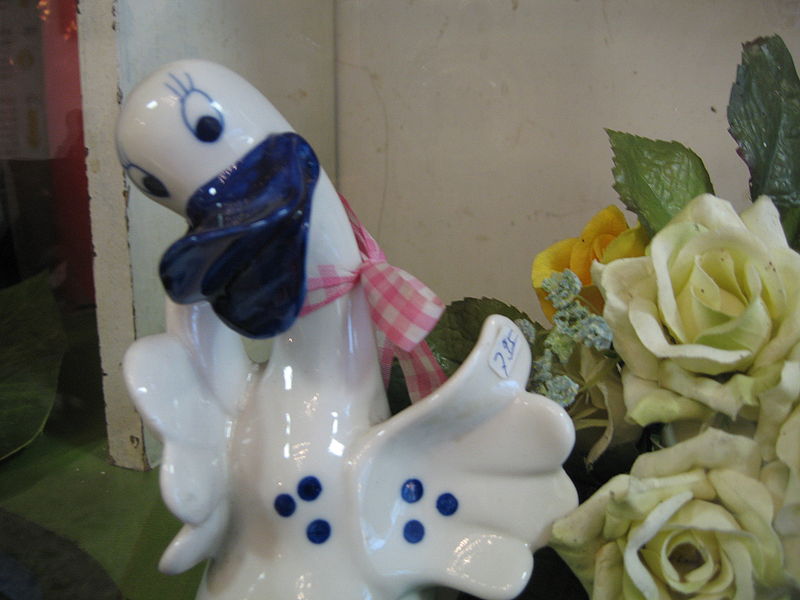
In films, television, and now video, we like spectacle-people in flashy clothes chasing each other in expensive cars. In our domestic life we seem to value convenience above all-the TV dinner which, if spilled on the nowax vinyl floor, can be wiped up in a second with the superabsorbent paper towel. Where convenience and flashiness converge, we have gadgets, which as a culture we crave. The same person who has kitsch sculpture in the garden may also own a golf cap with a little solar-powered fan in it or a telephone in the shape of a duck that quacks instead of rings.

Kitsch is perfectly suited to most people's passivity, short attention span, and shallow understanding, for it promises them immediate gratification requiring no special background knowledge or activity. It offers itself as instant art.

The fact that kitsch can aim for only a passive response explains why so much of it is sentimental, achieving its effect by evoking simple emotionslove of children, patriotism, religious devotion, and nostalgia-in utterly obvious and predictable ways. A good example here is the use of cuteness in kitsch. Cuteness is a group of features that evolved in mammalian infants as a way of making them attractive to adults. These "releasing stimuli" for nurturant behavior, as ethologists refer to cute features, include a head large in relation to the body, eyes set low in the head, a large protruding forehead, round protruding cheeks, a plump rounded body shape, short thick extremities, soft body surfaces, and clumsy behavior.5 The manufacturers of dolls, children's books, and greeting cards exaggerate all these features to get a positive response from customers. Now to portray a cute child in a painting, for example, is not by tself aesthetically objectionable, but to do so by painting the child's eyes four times the size of real eyes, with three-ounce tears in their corners, is objectionable. For it hits viewers over the head with its message; it tells them just how to react to the painting and
so leaves them with no cognitive steps to go through.

A basic feature of great art, we think, is that it challenges the audience to interpret it and react to it. Within limits, aesthetic value is proportional to the effort needed to process the work cognitively. That's why we prefer works which have subtlety and multiple meanings and which cannot be taken in at a glance. By eliminating these features, kitsch eliminates the potential for aesthetic experience of any worth.

The effortless response kitsch aims for is manifested in kitsch's lack of risk taking and genuine novelty. Kitsch always uses representation, for example, in a straightforward way; there is no questioning of the relation of the representation to what is represented, as there is in so much twentiethcentury at.

Corbis
Aesthetically, politically, and religiously, kitsch is always conservative. Aesthetically, it looks for images from traditional art that have already become icons, such as the Mona Lisa, the Last Supper, and the Eiffel Tower. It tries to tap their established acceptability and value to get a predictable reaction. In this way, kitsch is the opposite of avant-garde art, which tries to break with tradition and be appreciated in new ways. The political conservatism of kitsch comes out in its celebration of uncritical nationalism and nostalgia for the good old days. The past is seen as understandable, safe, and morally superior; that is why so many kitsch objects are, as the ads say, "antique style," e.g., the smoking stand designed as a miniature colonialstyle, potbelly stove, with an American eagle insignia on it. Religious kitsch, too, tries to tap feelings of satisfaction with tradition rather than, say, feelings of moral outrage at hypocrisy. People who love kitsch want no cognitive challenges and no social or ethical challenges. They want to live in an unambiguous world where each thing has one obvious meaning and is immediately recognizable as either likeable or not likeable.

This lack of an interest in novel and challenging experiences shows up graphically in a pastime that is closely related to kitsch and which supports the sale of many kitsch objects-tourism, travel sold as a commodity. The tour guide takes groups of tourists through "15 cities in 9 days," showing them sights familiar from postcards. They travel with people who speak their language, and the tour guide makes sure they never have to use the language of the countries they're visiting. Their prearranged meals are taken at restaurants that can serve them the kind of food they have at home, and nothing happens that the tour company can't handle for them. Indeed, they are treated much like spoiled children at summer camp. What they are paying for are easy, passive experiences with just a hint of the exotic to them, but not anything really strange and difficult to understand. The roaring mechanical hippos at Disney World are about their limit.

Just as tourists need do nothing but get on and off the bus, eat the food, take the standard photos with their instant cameras, and buy the souvenirs, so kitsch consumers in general do not have to meet any experience halfway- it comes all the way to accommodate itself to them, predigested and ready to be assimilated."

Morreall, John; Loy, Jessica (1989) Kitsch and Aesthetic Education
Journal of Aesthetic Education, Vol. 23, No. 4 (Winter, 1989), pp 67-69.

Tuesday, 14 June 2011

Kitsch and Aesthetic Education II (J. Morreall & J. Loy)


Postindustrial Culture

"Today, of course, we are far beyond the Industrial Revolution. The vast majority of workers are now in the service sector, using their hands and eyes to enter data into computers, drive trucks, and put cheeseburgers into paper bags. And because few work with materials such as wood, fabric, and metal, and fewer still do anything artistic, most are unable to appreciate or evaluate things aesthetically, or in many cases even functionally. [...]

Corbis
The self-deception purveyed by the "craft stores" is bad enough, but most people today don't even get as far as feeling a need to make anything with their hands. Nor do they see the connection between the general lack of such skills in our culture and the prevalence of bad taste. Indeed, they don't see the taste all around them, especially their own, as bad taste. Whatever the advertisers say is in vogue, they simply accept as in good taste. Their choices of home furnishings, for example, do not spring from any knowledge of how such things are made, nor even from any personal set of preferences. The furnishings in their homes are mere purchases dictated by advertising. Their "taste" comes from magazine articles and catalogs or, if they have more money, from a decorator. When next year new items, styles, and colors are declared in vogue, they are only too happy to replace the current contents of their home. Indeed, if their supply of money permits, they may buy a whole new house.

Most people today don't see planned obsolescence as a marketing gimmick; they embrace it, for it gives them a chance to make new purchases, and a good part of their identity lies in the act of purchasing. The bumper sticker "Born to Shop" and the Bloomingdale's motto for sales "Shop Till You Drop" are only partly ironic. For many people who make nothing themselves, shopping represents at least some connection to the world of material things and-perhaps a greater boon-some structure to their daily lives. They can shape their identities, too, of course, by their association with what they buy, the Rolex watch, the Calvin Klein jeans, the BMW.

The lack of taste so prevalent today results not only from people's lack of skills in making things, but also from their lack of skills in any of the performing arts. Consider music, which used to be something that ordinary people did-they played instruments, they sang, they danced. In the last half-century music has become less an activity and more a commodity to be passively consumed. Manufacturers and advertisers know that they can make more money by selling us records, tapes, compact disks, concert tickets, nd all the T-shirts and other paraphernalia that go along with today's music business than by selling us musical instruments and sheet music. And so that's what they sell us. Instead of getting together to play music and sing, we go to a concert to hear someone else play and sing, or worse, we clip the miniature tape player to our belts, the earphones to our heads, and we listen individually. The producers of popular music, and mass entertainment generally, of course, have a vested interest in a public that cannot play music or sing and has no fixed standards or personal taste; that is just the kind of malleable people who will buy whatever they are told to buy."


Morreall, John & Loy, Jessica (1989) Kitsch and Aesthetic Education
Journal of Aesthetic Education, Vol. 23, No. 4 (Winter, 1989), pp 66-67.

Saturday, 4 June 2011

Kitsch and Aesthetic Education (J. Morreall & J. Loy)

The Origin of Kitsch

"The term "kitsch," like the phenomenon, is modern. Coming into use in the 1860s among Munich artists and dealers, for whom it meant cheap artistic stuff, the term was in international use by the turn of the century. Several sources have been suggested for the word, among them the German kitschen, meaning to cheapen or to make do, and verkitschen, meaning to switch-sell. Today the word is applied far beyond painting and sculpture to furniture and interior design, to landscaping and television programs.

Perhaps the most often cited characteristic of kitsch is that it is in bad taste, but that is not enough to make something kitsch. There must also be an element of display. Kitsch objects call attention to themselves and their owners, who think of them as artlike and stylish, as endowing them, in Curtis Brown's words, "with an air of richness, elegance, or sophistication." (1)

Most scholars reckon kitsch to be less than two centuries old, although a few, citing Hellenic miniatures and medieval devotional pictures, have suggested that there was kitsch in mass cultures of the distant past. But even if we admit these few early examples, it is clear that kitsch was not a widespread phenomenon until the Industrial Revolution. Before modern times there were painters and sculptors with little talent, but their work was not kitsch. Nor were works of folk art, peasant art, and primitive art. Compared to works in the high European traditions, some of these items may have been simpleminded, even knick-knacks, but they lacked the pretentiousness of kitsch. The people who bought kitsch had at least a little familiarity with fine art and were looking for something equivalent to it, though not something involving the education and expense required by fine-art connoisseurship. These people and the objects they sought came together in the new manufacturing-commercial culture that followed the Industrial Revolution.

iamyouasheisme.wordpress.com
Before manufacturing, only the wealthy and aristocratic had the means to be well educated, cultured, and intellectual and so to participate in the world of the fine arts. Most people were kept busy with the simple necessities of life and had neither the education, time, money, nor interest to patronize the fine arts. What art they had was folk art and grew largely out of their craft traditions. (Indeed, "folk art" is still often used to mean the crafts.) With the Industrial Revolution, however, thousands of people were drawn into the cities to work in the new factories or to sell the products of the factories. There they did not get an education in fine art, but they did learn one of its features, a social rather than aesthetic feature, the use of fine art by the rich to mark their wealth and status.

When factory workers and members of the middle class had a little extra income, they often wanted to buy things to decorate their homes as well as to give them a little status among their neighbors. The folk art traditions of their ancestors had largely been lost, and they did not have the money, time, or education for art patronage. But while they could not afford real fine art, they could afford mass-produced copies of fine art and other artlike objects-they could afford kitsch.

The lower classes bought kitsch in emulation of the rich. While the folk art of their grandparents had been made by "the folk" themselves, kitsch was designed by the upper classes to sell to them. It came from above. (2)

There were two ways in which the new industrial and commercial culture made kitsch possible. First, the new factories could mass-produce artlike items at prices the lower and middle classes could afford. And being able to afford kitsch was the only requirement for owning it. No involvement in the art world was needed-kitsch owners did not have to know artists, learn about their techniques and reputations, or patronize the arts. They didn't need to deal with artists at all; they bought the stuff from retailers. While it was not possible to be a mere art consumer, at least before the modern age, being a consumer only of kitsch was the norm.

But it was not only by mass-producing artlike objects that the new culture made kitsch possible, it was also by producing the people who would find these objects appealing, people who knew little about fine art, who had not developed aesthetic sensitivity, but who wanted nonetheless to decorate their homes and show off with artlike objects. These people were the aesthetically deprived lower class and a good proportion of the middle class."


Notes:
1. Curtis Brown, Star-Spangled Kitsch (New York: Universe Books, 1975), p. 9.
2. Dwight MacDonald, "A Theory of Mass Culture," in Mass Culture: The Popular Arts in America, ed. Bernard Rosenberg and David M. White (Glencoe, Ill.: Free Press, 1957), p. 60.

Morreall, John & Loy, Jessica (1989) Kitsch and Aesthetic Education
Journal of Aesthetic Education, Vol. 23, No. 4 (Winter, 1989), pp 63-65

Saturday, 9 April 2011

Habitus

“Una classe o una frazione di classe si definisce non solo attraverso la posizione nei rapporti di produzione che può venir individuata mediante indicatori quali la professioni, il reddito o anche il livello di istruzione, ma anche attraverso una determinata proporzione tra i sessi, una determinata distribuzione nello spazio geografico (che, dal punto di vista sociale non è mai neutro), e mediante tutto un insieme di caratteristiche ausiliarie che possono fungere, come esigenze sottintese, da principi effettivi di esclusione o di selezione, senza venir mai formalmente enunciati (è il caso, per esempio, dell’appartenenza etnica o sessuale); molti criteri ufficiali funzionano in effetti da copertura a criteri nascosti, dato che il fatto di esigere un determinato titolo di studio può essere ad esempio un modo per esigere di fatto una determinata provenienza sociale” (Bourdieu, 2001; 104)

Habitus di classe: Principio unificatore e generatore di diversi pratiche; forma incorporata della condizione di classe e dei condizionamenti da essa imposti. (Bourdieu, 2001; 103)

“The anthropologist Pierre Bourdieu saw this clearly. Everyday life is not a system of representations or performances, he wrote, but a "system of structured, structuring dispositions ... which is constituted in practice and is always oriented toward practical functions”. He called this system the habitus, or practical sense. "Practical sense is a quasi-bodily involvement," he went on. It is "converted into motor schemes and body automatisms" (66, 69). […]the habitus is only a predisposition, "a present past that tends to perpetuate itself into the future," a way to proceed lodged in an actor capable of thinking and making judgments, so that in "the necessary yet unpredictable confrontation between the habitus and an event," new solutions are improvised. As both a sensorimotor and an ideological quality, the habitus is a flexible disposition that allow one to act in a way that is at once habitual and improvisatory, rote and novel. It is above all an "art of inventing" (54-56). And so we arrive at a more concrete sense of the everyday, in every sense of the word. One definition of everyday life might be "The nexus of spaces and times that repeatedly trigger bodily habits and cultural memories-the habitus." Everyday life can be oppressive or liberating, depending on the ways it is organized temporally and spatially. Everyday life shapes selfhood and personhood through material, and particularly bodily, practices, but its critical quality is time, as Michel de Certeau realized. It is the repetition and routine of everyday life that teaches our bodies the habitus.(Upton 2002, 719-720)

“Spazio fisico e spazio sociale fanno parte della stessa ‘trama che connetta’ l’uomo al suo ambiente. Si tratta di due dimensioni che si compenetrano reciprocamente: spirali di senso legano l’una all’altra. Non esistono dicotomie. Non c’è una cosa che agisce sull’altra, piuttosto incontri, interpenetrazioni, corrispondenze, reciprocità di dimensioni coesistenti. È dunque necessario intraprendere percorsi interpretativi in grado di assumere come irrinunciabile la complessità e la multidimensionalità dello spazio. Uno spazio sfaccettato e poliedrico in cui se mescolano: spazio sociale e spazio simbolico (Bourdieu 1995); conoscenza, potere ed eterotopie (Foucault 1994); pratiche spaziali, rappresentazioni dello spazio e spazi della rappresentazione, altrimenti declinati in spazio percepito, spazio concepito e spazio vissuto (Lefebvre 1991); spazi del margine, antagonisti e incubatori di pratiche antagoniste (Hooks 1998).” (Attili 2008, 57)

“Issues of identity and consumption converge in the concepts of ‘taste’ and ‘lifestyle’, that is, systems of practices through which individuals classify themselves by their classification of consumer goods as more or less desirable, acceptable or valuable (Bourdieu 1984) […] knowledge of status codes, or rules of legitimacy, allows consumers to display ‘good’ taste and thus establish their distinction. […] tastes for specific kinds of consumer goods are implicitly socialized by social class and status or are consciously learned as means of integration into new social groups.” (Zukin y Smith Maguire 2004, 181)

“In order for a certain formation to have an expressive power, it should originate from the cultural experience of a people--from their soul. This is the ultimate origin of art. The artist is the creative imagination of this soul.” (Mitias 1999, 76)

Attili, Giovanni. Rappresentare la città dei migranti. Milano: Jaca Book, 2008.
Bourdieu, Pierre. La distinzione. Critica sociale del gusto. Bologna: Il Mulino, 2001 [1979].
Mitias, Michael H. «The Aesthetic Experience of the Architectural Work.» Journal of Aesthetic Education, Vol. 33, No. 3, 1999: 61-77.
Upton, Dell. «Architecture in Everyday Life.» New Literary History, V 33 Nº 4, 2002: 707-723.
Zukin, Sharon, e Jennifer Smith Maguire. «Consumers and Consumption.» Annual Review of Sociology, V30, 2004: 173-197.

Saturday, 15 January 2011

Kitsch (P. Crick)

"It is a surprise to find how, in the biological realm, the endlessly evolving forms of life appear as anticipations of distinctive forms of human social behaviour. Ignorant of the slur which we place upon them and of the effect they have upon our metaphors, parasites such as ivy, mistletoe, or the pernicious flea, pronounce the joys that can be gained just by shaping one's life around the life style of a host. Why struggle for support or food when you can get someone else to do all the hard work for you? Such is the question parasitism suggests. A refutation of the argument is hard to find.

The price which the parasite pays for its upkeep is dependence, but offered such support by a more energetic organism, all else follows. Generally, in the natural world the right degree of maintenance is forthcoming; but should the host die, then the parasite will probably follow suit. The key fact in this sort of relationship is that it is a very one-way affair, and irreversible.

In human culture, a nearly identical partnership is that which holds between Art and Kitsch. They are interinvolved, but in an irreversible mode. Lift, for example, all trace of Kitsch from a society and Art would still be able to flourish. It might, indeed, expand its range and become more successful. Extract, however, Art from the structure of a culture— prise out its nervous system—and, after a sufficient pause, any sign of Kitsch would also vanish. Perhaps in this instance the culture might vanish, too.

What, then, are the characteristics of Kitsch as a phenomenon which define and ensure its dependency on Art as the prior form ? [...]


Firstly, then, a work of art, although always the product of thought and imagination and, of course, very hard work, is not deliberative. The creative artist never sets out to calculate responses, for calculation would inevitably destroy the spontaneous character which enters into the development of the artefact. The creative act, the work of making the poem, the painting, the sculpture, does not preclude reason or reasoning; but the intellect combines with and fuses into the passionate element throughout the process, under a principle which ensures that the completed work will submit itself to an open and diverse response on the part of each differing perceiver. A work of art does not make use of its understanding of the nature of the medium being employed to control the psyche of the responding individual, as is the case in the sophisticated product of advertising on television where Kitsch photography and montage both of shot and of speech are the order of the day. Art does not seek to manipulate. It does not take up a position of power in relation to the recipient, as advertising will. It does not see the properties of the language of the medium as a weapon of approach. The artist is not self-conscious in that sense. Calculation as to effect will always mean that one who does so also calculates the precise reward of that effect. Calculation of effect is also the path to the manifestation of the sentimental. In Kitsch, deliberation and indulgence walk hand in hand, as courtier and courtesan. Flattery is its essence. [...]

Secondly, Art knows nothing of closure. The artefact may sometimes be simple; but it is never simplistic. Art does not insult the complexity of nature and of Man through an act of reduction. Nor is there any finality in a true work of art, either in its internal state, nor when it is experienced from the outside. The completed form of the work, its structural harmony, is a resolution of conflicting forces in the originator—a momentary resolution,
not a terminal fusion of those forces. In its external aspect, the artefact gives the observer or participant work to do. It puts questions, starts a mystery, inseminates the observer with new unforeseen questions, leaves itself open, leaves itself exposed to the world like a flower; all this, while giving delight; whereas a Kitsch product is final in quality, says one borrowed definite thing, and then, no more. It arouses certain secondary pleasures in those who crave Kitsch but asks no questions, is unmysterious and shallowly explicit. Kitsch is very much a by-product of social anxiety, and tries very hard to reassure. It seeks to protect both its maker and its consumer from the rigour of the real. [...]

The third negation of Kitsch is a double negation. Art is never un-selfreferenced. Kitsch, on the other hand, bears the stamp of its own ignorance. Whenever a Kitsch product falsely offers itself as a work of art, analysis of it gives no evidence that the work anywhere knows itself to be a work of art. The authentic work knows itself to be such because the creator of it discovers as he goes along that he is a maker of the new (and not just the maker of a novelty). There is always concrete evidence within a work of art of a technical kind which will show on inspection that not only is the artist engaged in a search but that he is searching with a method which is provisional in its essence. Moreover, this note of provisionality always enters into the expressive form which the act of search takes. Such an attitude shows what it means to assert that a work of art is self-aware. It is just one step beyond this from self-awareness to self-reference. Selfawareness of this tentative order ensures that the work of art will indirectly comment upon its own use of the medium. It will show itself to exist in a state of tension with its own technical means, and its own specific cultural inheritance.

A further aspect of the self-referencing function resides in the fact that a work of art, simply by existing in its 'resolved' state, can be seen by observers to relate both to past works by the same artist, and to those which will emerge in the future. The relationship articulates the general quest of that artist. Kitsch can never exemplify either search or quest in this sense. The third great difference between Art and Kitsch occurs in the sphere
of decoration. Art is not self-indulgently decorative. In a Kitsch product, there is no inner formal necessity between the ornamental element and motif. The decoration is used simply as cosmetic to whatever is being
centrally presented. [...]

The last and fifth major contrastive difference between the two modes of making is to some extent a continuation by other means of the issue of decoration. A work of art, if looked at in terms of its rituahstic aspect, is never ritualistic without substance. The ritualism of Kitsch, however, gives full reign to the resources of human fancy and fantasy without regard to the traditional base of accredited ritual. The authenticity of the ritual domain in Art is derived from its historical validity—the ideological validity of the field of ritual reference at the time at which any given work of art invoking it is made. A work of art can, of course, evoke past ritualistic forms, not (as may be the case) as quotation, but rather in the form of celebrating the climate of a previous epoch and its value-system. But whenever that happens, it will treat the material referred to in the language of the present and not just naively import the ritual mode unaltered. Kitsch imports, and borrows, intact. Art alludes, and transforms. [...]

Today, Kitsch is the flourishing formula of a mass culture. Its presence can be detected in every social practice from religion, through all mediacommercials, to athletics, even. Kitsch is the great hedonist vehicle of our time, a parasite now grown to leviathan maturity, while the host on which it feeds remains comparatively small. But to this depressing fact there is an opposing optimistic parable. In certain Latin American countries, the scourge of extreme poverty has brought into being a type of artistcraftsman, who lacking all plant or technology has taken to recycling chosen items of garbage (Strassenschlamm) into new and beautiful and useful individualized products, such as oil-lamps, which' are sold at local street-markets. They are sold not (yet) to tourists, but to ordinary local people.

This model of creative courage in which an innovation drawn from the uninviting gutter of industrial waste breeds beauty alongside utility, has something in common with the way in which Western artists have taken up facets of the enormous Kitsch output in their own culture and through a deft act of allusive irony incorporated them into fresh aesthetic statements. Modem art therefore engages in a crucial if low-key dialogue with its feverish parasite. On each occasion where that irony is manifested a work of art becomes a work of criticism, and a work of criticism becomes a work of art.

Crick, Philip (1983) "Kitsch". In: British Journal of Aesthetics, vol. 23, no. 1.
Related Posts with Thumbnails